
If you’re searching for clarity on today’s shifting financial landscape, you’re likely trying to understand how macro forces, policy changes, and capital flows affect your money. This article is designed to do exactly that—break down the forces driving global liquidity trends, explain what they mean for investors, and show how to adjust your portfolio, tax strategy, and budgeting approach accordingly.
Many investors struggle to connect headlines about interest rates, monetary tightening, or capital inflows with practical financial decisions. Here, we translate those complex dynamics into clear, actionable insights grounded in foundational finance principles and real-world portfolio strategy.
Our analysis draws on data-driven market signals, historical liquidity cycles, and established investment frameworks to ensure accuracy and relevance. By the end, you’ll understand where liquidity is expanding or contracting, how that impacts asset prices, and what strategic moves can help protect and grow your wealth in the current environment.
Start with an anecdote about checking my portfolio during the 2020 crash. I remember watching markets freeze and realizing liquidity had vanished. That was my wake-up call: CASH FLOW matters more than headlines.
Today, global liquidity trends are tightening again, and investors feel it in ways. Liquidity means how easily money moves through banks, markets, and credit systems. When it shrinks, loans cost more and risk appetite drops.
Some argue fundamentals matter more than liquidity signals. I disagree because I have seen portfolios stall when funding dries up.
• Watch bank balance sheets.
• Track credit spreads.
PRO TIP: protect cash buffers.
Pattern 1: The Great Central Bank Unwinding
For over a decade, markets were fueled by Quantitative Easing (QE)—a policy where central banks create money to buy bonds and inject liquidity into the economy. In simple terms, it’s money printing designed to stimulate growth. Now, the Federal Reserve and European Central Bank are reversing course with Quantitative Tightening (QT), shrinking their balance sheets and pulling money out of the system.
Why does this matter to you?
Because liquidity acts like oxygen for financial markets. When it’s abundant, asset prices rise easily. When it’s restricted, valuations compress—especially in growth and tech stocks that depend on cheap borrowing and future earnings projections. Reduced liquidity also raises interest rates, increasing costs for mortgages, credit cards, and corporate loans. (Yes, that car payment just got more expensive.)
Some argue markets have already “priced in” QT. But history suggests tightening cycles often reveal hidden weaknesses—overleveraged firms, inflated valuations, fragile balance sheets. Watching global liquidity trends can give you an early edge instead of reacting late.
So what’s the opportunity?
In a QT environment, disciplined allocation pays off:
- Focus on high-quality, cash-flow-positive companies with strong balance sheets
- Add short-term bonds for stability and income
- Maintain selective exposure rather than broad speculation
Pro tip: Short-duration bonds tend to be less sensitive to rate hikes, making them useful defensive tools.
Volatility also opens a tax advantage. Tax-loss harvesting—selling underperforming assets to offset capital gains—can improve after-tax returns and preserve capital for reinvestment.
QT isn’t just a threat. It’s a filter. And filters reward prepared investors.
Pattern 2: The Surge in Private Credit and Non-Bank Lending
As traditional banks retreat—pressed by tighter regulations and higher capital requirements—private credit has stepped in to fill the gap. Private credit refers to loans made by non-bank institutions such as private debt funds, hedge funds, or specialty finance firms. Think of it as lending that happens outside your neighborhood bank branch (no marble floors required).
Filling the Void
After the 2008 financial crisis and more recent regional bank stress, banks tightened underwriting standards (Federal Reserve Senior Loan Officer Opinion Survey). Middle-market companies still needed funding, so private lenders moved fast. The result? Billions flowing into direct lending funds, especially in the U.S. and Europe.
What This Means for Liquidity
We now have a two-tiered system:
- Public markets: More transparent, but often tighter credit conditions.
- Private markets: More flexible capital, but less disclosure and access.
While public liquidity can contract during downturns, private markets may appear stable—until they’re not. Because valuations aren’t marked daily, risks can stay hidden longer. This dynamic is increasingly tied to global liquidity trends.
The Risk Factor
Critics call this “shadow banking”—financial activity happening outside traditional oversight. They argue rising default risk and higher interest rates (often 8–12%+) could amplify systemic stress (IMF Global Financial Stability Report). That concern isn’t unfounded.
However, supporters counter that private lenders often use stricter covenants and closer monitoring.
Investment Portfolio Strategy
Retail investors can gain exposure through:
- Business Development Companies (BDCs)
- Listed private equity firms
Pro tip: Review leverage ratios and default history before investing.
For broader context, explore the 7 early financial shift signals that indicate a market cycle change to see how credit expansion often precedes turning points.
Pattern 3: A Bifurcated Cross-Border Capital Flow
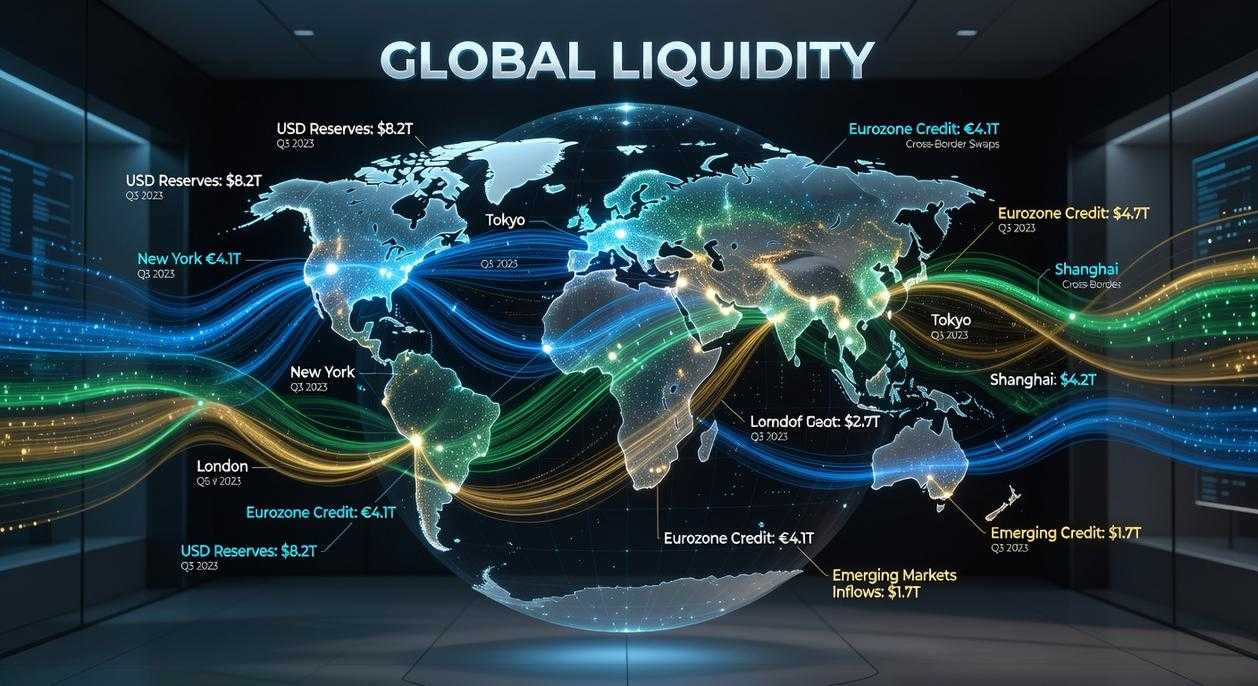
Capital isn’t just moving—it’s splitting.
On one side, we have the “flight to safety”—a shift of money into assets perceived as stable during uncertainty. With a strong U.S. dollar and higher interest rates, global investors are pouring funds into U.S. Treasury bonds. Why? Higher yields plus relative stability. According to U.S. Treasury data, foreign holdings of Treasuries rise during tightening cycles as investors seek predictable returns.
The foundational driver here is interest rate parity—a finance principle stating that capital flows toward countries offering higher risk-adjusted returns after accounting for currency differences. When U.S. rates rise, capital often follows (money can be surprisingly patriotic when yields improve).
Meanwhile, emerging markets feel the squeeze. Liquidity drains as investors convert local currencies into dollars. This divergence is reshaping global liquidity trends in real time.
Geopolitics adds another layer. Trade tensions and regulatory uncertainty have redirected capital:
- Reduced flows into China amid policy risk
- Increased investment into India’s manufacturing push
- Growing allocations to Mexico and Southeast Asia due to nearshoring
Money is also targeting specific sectors:
- AI infrastructure (data centers, semiconductors)
- Energy security projects
- Onshoring and reshoring manufacturing initiatives
Practical Tip: If you’re allocating internationally, compare interest rate differentials before investing in foreign equities. Step 1: Check central bank rates. Step 2: Evaluate currency trend versus the dollar. Step 3: Assess sector alignment with policy support.
Some argue diversification alone offsets these shifts. That’s partially true. But ignoring rate differentials? That’s like ignoring gravity (markets eventually pull downward where yield is weak).
Smart investors track both geography and sector momentum.
Actionable Steps for the Current Liquidity Environment
Public market liquidity is thinning, while private and regional capital shifts without warning. In other words, the tide isn’t just going out—it’s changing direction. That uncertainty makes disciplined decision-making non‑negotiable.
Some investors argue that tightening conditions are temporary and that staying fully invested maximizes upside. Historically, rebounds can be sharp (just look at 2020’s snapback rally, per Federal Reserve data). However, betting on speed alone ignores how global liquidity trends influence asset pricing, credit access, and volatility cycles.
So what’s practical? First, increase cash reserves. In constrained markets, cash isn’t idle—it’s optionality. When quality assets become mispriced, liquidity lets you act while others scramble. (Pro tip: target at least 6–12 months of deployable capital, depending on risk tolerance.)
Next, reassess exposure to long-duration assets and emerging markets. Rising financing costs compress future valuations. While some call this overly cautious, aligning allocations with tightening conditions protects downside—and preserves flexibility for the next upswing.
Position Yourself Before the Next Market Shift
You came here to understand how today’s market forces — especially global liquidity trends — are shaping investment opportunities and financial risk. Now you have a clearer view of how capital flows, monetary shifts, and macro signals directly impact your portfolio, tax exposure, and long‑term financial stability.
The reality is this: when liquidity tightens or expands, unprepared investors feel it first. Missed signals can mean underperforming assets, unnecessary tax burdens, or stalled wealth growth. But when you understand the patterns behind the movement, you gain the ability to act instead of react.
Now it’s time to apply what you’ve learned. Review your portfolio allocation. Stress‑test your strategy against current liquidity conditions. Adjust your tax positioning and cash reserves before the next shift forces your hand.
If you’re serious about protecting and growing your wealth, don’t wait for the next downturn to expose weaknesses. Use proven financial shift signals, disciplined portfolio strategies, and structured budgeting systems to stay ahead. Thousands rely on structured, data‑driven financial frameworks to navigate uncertainty with confidence — you should too.
Take action now: reassess your strategy, implement smarter allocation tactics, and position yourself to capitalize on — not fear — the next wave of market movement.