

If you’re searching for a smarter way to grow, protect, and manage your money, you’re in the right place. Financial success isn’t about luck or chasing every new trend—it’s about understanding foundational principles, recognizing strategic shifts, and applying disciplined portfolio and tax strategies that actually work.
This article is built to help you navigate financial shift signals, strengthen your grasp of core money principles, and apply practical investment portfolio strategies that align with long-term goals. We’ll also explore tax compliance tactics and smart budgeting hacks that keep more of your earnings working for you.
Our insights are grounded in proven financial frameworks, real-world market analysis, and time-tested wealth-building methods—including the power of compound interest growth to accelerate results over time.
Whether you’re refining your current plan or starting fresh, you’ll gain clear, actionable guidance designed to help you make confident, informed financial decisions in an ever-changing economic landscape.
Money can work harder than you do—if you understand how. Compound interest (interest earned on both your original money and past interest) turns small savings into something powerful. Think of it as compound interest growth: a snowball rolling downhill.
Option A: Save $1,000 at 2% simple interest.
Option B: Invest $1,000 at 7% compounded annually.
After 30 years, A barely grows. B multiplies several times over (yes, time is dramatic like that).
Simple interest pays you once.
Compound interest pays you on payments.
According to the SEC, starting early increases long-term returns. Pro tip: automate contributions so time does lifting.
Simple vs. Compound Interest: The Critical Difference
Let’s be honest: most of us were never properly taught this stuff. We hear “interest” and nod along, but no one explains why one type quietly builds wealth while the other barely moves the needle. And that confusion? It costs REAL money.
Simple Interest: The Static Option
Simple interest is calculated only on the original amount you invest, called the principal (your starting money). It does not change over time.
If you invest $1,000 at 5% simple interest, you earn $50 per year. After three years, that’s $150 total. Sounds fine… until you realize your interest never earns interest. It just sits there. (Like a gym membership you keep paying for but never use.)
Compound Interest: Interest on Interest
Compound interest is calculated on your principal plus any interest already earned. In Year 2, you’re earning 5% on $1,050—not just $1,000. That small shift is the engine behind compound interest growth.
And here’s the “aha!” moment: over decades, that difference becomes exponential. According to the U.S. Securities and Exchange Commission, compounding significantly increases long-term returns.
Some argue simple interest is “safer” or easier to understand. Sure. But easier doesn’t mean better.
Pro tip: The earlier you start compounding, the less you have to invest later to reach the same goal.
The “Snowball Effect”: Seeing Compound Interest in Action
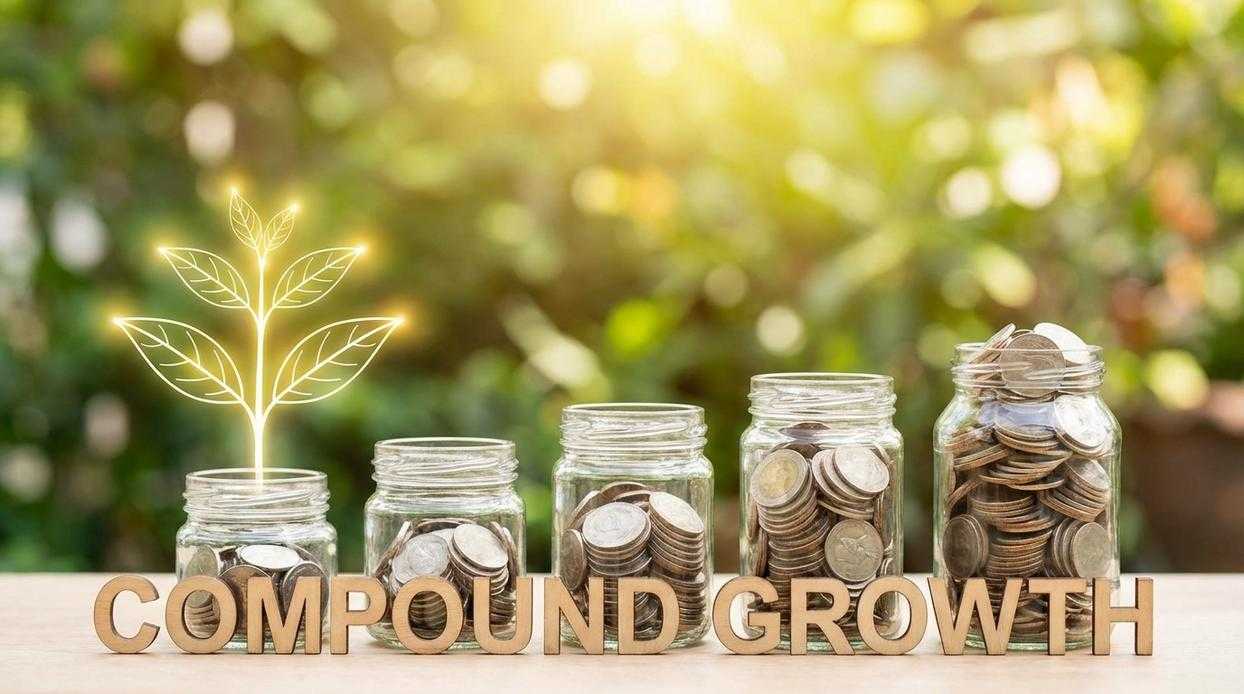
Compound interest isn’t hype. It’s MATH. And the math is relentless.
At its core, compound interest growth runs on three simple levers:
- Principal: your starting amount (the seed money).
- Rate of Return: the percentage your money earns each year.
- Time: how long you leave it untouched.
Pull one lever and growth changes. Pull all three wisely, and the results can be dramatic. According to the U.S. SEC, even small differences in annual return can significantly impact long-term outcomes (Investor.gov).
Let’s make this real with $1,000 invested at 7% annually:
| Year | Start Balance | End Balance | Interest Earned |
|---|---|---|---|
| 1 | $1,000.00 |
$1,070.00 | +$70.00 |
| 2 | $1,070.00 | $1,144.90 | +$74.90 |
| 5 | $1,310.80 | $1,402.55 | +$91.75 |
| 10 | $1,838.46 | $1,967.15 | +$128.69 |
Notice something? The rate stays the same, but the dollars earned each year KEEP INCREASING.
That’s the snowball effect. In year one, you earn $70. By year ten, you’re earning $128.69 annually—almost double—without adding a single extra dollar.
Critics argue 7% isn’t guaranteed. True. Markets fluctuate. But historically, long-term diversified stock portfolios have averaged about 7–10% annually after inflation (S&P historical data). The principle still holds: time magnifies returns.
Graph this and you won’t see a straight line. You’ll see a CURVE—one that bends upward as momentum builds. The longer it rolls, the faster it grows (just like that snowball in every winter movie montage).
Pro tip: Want this curve working in your favor? Start early—and understand why diversification is a fundamental rule in finance: https://hanlerdos.com/why-diversification-is-a-fundamental-rule-in-finance/
Why Time Is Your Most Powerful Financial Asset*
I once met two friends at a coffee shop arguing about investing. One said, “I’ll start when I make more money.” The other had already begun with small automatic deposits. That conversation stuck with me.
Here’s why.
- Person A invests $200 a month starting at 25.
- Person B invests $300 a month starting at 35.
Assume they both earn the same average annual return of 8%.
By 65, Person A has invested $96,000. Person B has invested $108,000. So B put in more cash.
But thanks to compound interest growth, Person A ends up with significantly more—because their money had an extra decade to snowball. (Think of it like giving your money a 10-year head start in a marathon.)
That’s the high cost of waiting. Time quietly multiplies what effort alone cannot.
If you want a quick way to grasp this, use the Rule of 72:
72 ÷ interest rate = years to double.
At 8%, your money doubles about every 9 years.
Some argue you should wait until you can invest more. I get that. Bigger contributions feel powerful. But starting earlier—even with less—often wins the race.
Pro tip: Automate small investments now. Future you will be very grateful.
Harnessing Compounding in Your Everyday Finances
Most people meet compounding through a sleepy savings account. Nice, polite, predictable. But the real magic shows up when you step into index funds, ETFs, or dividend-paying stocks, where average long-term returns have historically been higher (yes, this is where money actually does push-ups).
In other words, compound interest growth thrives on time and return rates. The higher the rate, the harder your dollars hustle.
So, what can you do?
- Automate investments with recurring transfers.
- Reinvest every dividend through a DRIP.
- Increase contributions whenever income rises.
First, automation. “Pay yourself first” means money moves before you can spend it on late-night takeout. Set it, forget it, let it snowball.
Next, a DRIP—Dividend Reinvestment Plan—automatically uses payouts to buy more shares. Those shares generate dividends of their own, and the cycle repeats.
Pro tip: review allocations annually to stay aligned with goals.
Starting today beats waiting for someday. Many people frame the decision as A vs B:
- Option A: Wait until you have “more money.”
- Option B: Invest small amounts consistently now.
Option A feels safer (and oddly responsible). But time lost is growth lost. Option B leverages compound interest growth, where earnings generate their own earnings over time.
Consider $100 monthly for 20 years versus $300 monthly for five. The first often wins because time compounds in the background.
The real hurdle isn’t knowledge; it’s inertia. Start small. Automate contributions. Adjust later.
Begin now, and let time—not timing—do the heavy lifting.
You came here to understand how to take control of your finances and make smarter, more strategic money decisions. Now you have a clearer path—one built on strong financial foundations, disciplined portfolio strategies, tax-aware planning, and practical budgeting tactics that actually work.
The real pain point isn’t lack of income. It’s uncertainty. It’s watching opportunities pass by because you’re unsure where to allocate capital, how to optimize taxes, or how to structure your portfolio for long-term compound interest growth. Left unchecked, small inefficiencies today turn into massive missed gains tomorrow.
The solution is consistent, informed action. Apply the financial shift signals. Strengthen your foundation. Align your investments with clear strategy. Tighten tax compliance. Optimize your budget so every dollar works harder for you.
Take Control of Your Financial Momentum
If you’re tired of second-guessing your financial decisions and want a structured system that turns income into lasting wealth, now is the time to act. Use proven portfolio strategies, tax-smart tactics, and disciplined budgeting frameworks designed to eliminate guesswork and accelerate results.
Thousands rely on structured financial principles to reduce risk, improve clarity, and build long-term security. You can do the same.
Start implementing these strategies today. Review your portfolio, adjust your allocations, and put a smarter financial system in place now—because the sooner you act, the faster your money starts working for you.